Please notice a new survey about student-led conferences is to the left. It will help me plan for the conference day with your children better, and will provide valuable feedback about the perceived worth of the event itself. Thank you for clicking.
Please also notice the new tab above. It is a permanent link to each current unit plan for Core Knowledge. It will help you plan trips to the library, documentary watching, AND MORE!
Friendly Reminder:
There is still some chance we might get some colorful results from our beet ingestion on Tuesday. If something interesting happens (or did happen), please have your second grader bring the science experiment report back in on Monday. Thank you to those families who helped get the report slips back. Dr. Currey said we might have had some other variables going for us. We'll figure out what to do with the data we have next week. It's all a learning process!
Next Week Preview:
Monday:
Field trip to Lan Su Chinese Garden and lunch at the House of Louie. Please help your second graders dress warm, in layers, but still in uniform (they did a great job on our November field trip!). Our tour is in the afternoon, so it will be a bit warmer, but still, it's January!
Monday we will also be taking a break from rubber band bracelets and necklaces. They are fun, colorful, and help develop fine motor skills, but we need a day off. If students bring them to school on Monday, they will put them in their backpacks. We will talk about them and try again on Tuesday, hopefully with some self-monitoring and management in place.
We will continue our study of Ancient China, learning more about the Great Wall, inventions of the ancient Chinese, and beautiful jade.
Thursday:
Come between 4:00 and 6:00 to view the Science Fair displays and exhibits. This is the time for your second grader to fully explain our fascinating experiment and what we learned, with display and all (no samples, though!).
Friday:
ON-CAMPUS fieldwork day. We have the Audubon Society coming to teach us about amphibians and reptiles in preparation for our Cycles of Nature unit, as well as the Talk about Trees Lady to teach us about that wonderful renewable resource, as well as papermaking (paper is another invention from ancient China!). We will also fit our entire Simple Machines unit into this day, so don't let your second grader weasel out of it (not that they'd want to! I LOVE simple machines!).
Week in Review:
Saxon Math (.pdf):
Lessons 57, 58, 59: "equal groups" stories (what is multiplication?), "groups of"; identifying and drawing lines of symmetry (divide it in half and both sides are the same); writing division problems in three ways (division symbol, division "house," fraction bar):
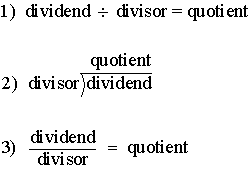
Division and multiplication are huge concepts, and we will continue to work with it a lot. Saxon Math has second graders show "equal groups" with circles, but I've been encouraging them to simply draw arrays, as it is more organized, practices the concept of arrays, and more often leads to the correct answer.

We have also started timing our practice of x7! Keep practicing! At school we practice with wrap-ups (visual, kinesthetic, auditory, verbal), oral fact practice sheets (visual, auditory, verbal), class fact practice sheets (visual, auditory, verbal, kinesthetic). Sadly, beyond understanding what multiplication is, and why it is so great, the only thing for mastering the times tables is practice, practice, practice. Actually, that is not sad at all, as that means anyone who is willing to put in the work will find success! I'm sure there are great apps, games, videos, and plenty of other engaging ways to practice at home. There are also flash cards at the dollar store.
Riggs/IEW:
We are continuing to review spelling rules and parts of speech with our Riggs spelling words. We will be doing a brief trip through the writing process (KWO to final draft) next week about courage, the character trait of the month. Today we talked about what courage is, and the different kinds and situations that call for it. If you are so moved, I encourage you to talk with your second grader about courage, the different kinds, and specific ways they have shown courage (apologizing, speaking up, saying no or yes, trying something new, doing something that looks scary, etc.). Who in your family has shown courage? Who are your heroes and do they exhibit courage? What do your family morals or beliefs say about courage? It could be an interesting conversation!
Core Knowledge:
Map of Asia and China, locations of: India, China, Japan, Pacific Ocean. Great Wall of China (and Mongolia!), Beijing the capital, Yellow River, Yangtze River. Which direction rivers flow (downhill, and eventually to the ocean, which ocean do we share with China, why Japan might have tried to invade China, why Japan is called the Land of the Rising Sun, AND MORE!
We also read Zen Shorts, another lovely John J. Muth book. Second graders make great philosophers.
Finally, we worked and struggled with tangrams, which is a traditional game in China: pictures and stories told using a set of seven tans. We read Grandfather Tang's Story and created many of the figures in the story with our own tangrams.


1. You must use all seven tans (pieces).
2. All tans must touch at least one other tan.
3. Tans may not overlap.
The rules for helping in second grade are simple, as well:
1. Offer help (don't just bust in and start help!): "It looks like you could use some help."
2. Offer advice and encouragement to your friend.
3. Model it for your friend.
4. Don't DO it for your friend!

For second grade tangrams, we also added these two rules:
1. Count the pieces in and out of the bag (to be resourceful and responsible).
2. No touching another person's tangrams (see helping rule 4 above).
As a class, we also touched on these important concepts for life:
- The value of "sweet success," and how struggling through a challenge makes the victory that much better (as opposed to having someone simply do it for you).
- If we want help, we should be actively trying to do something (don't just sit there!).
- Most things that are enjoyable and/or worth doing are also challenging to some degree.
- Games have rules to make them interesting and fun.
 |
| It takes some thinking! |
- Fine motor skills.
- Logic and problem-solving skills.
- Spatial and geometric reasoning.
- Perseverance.
- Verbal skills (helping without doing!).
 |
| Wheels were turning to make each figure! |
 | |
| Our first successful tangram! |
 |
| It's challenging to help without doing it for the person! |
 |
| Success feels so much better when you get there with minimal help! |
 |
| Friends help friends succeed and grow! |
